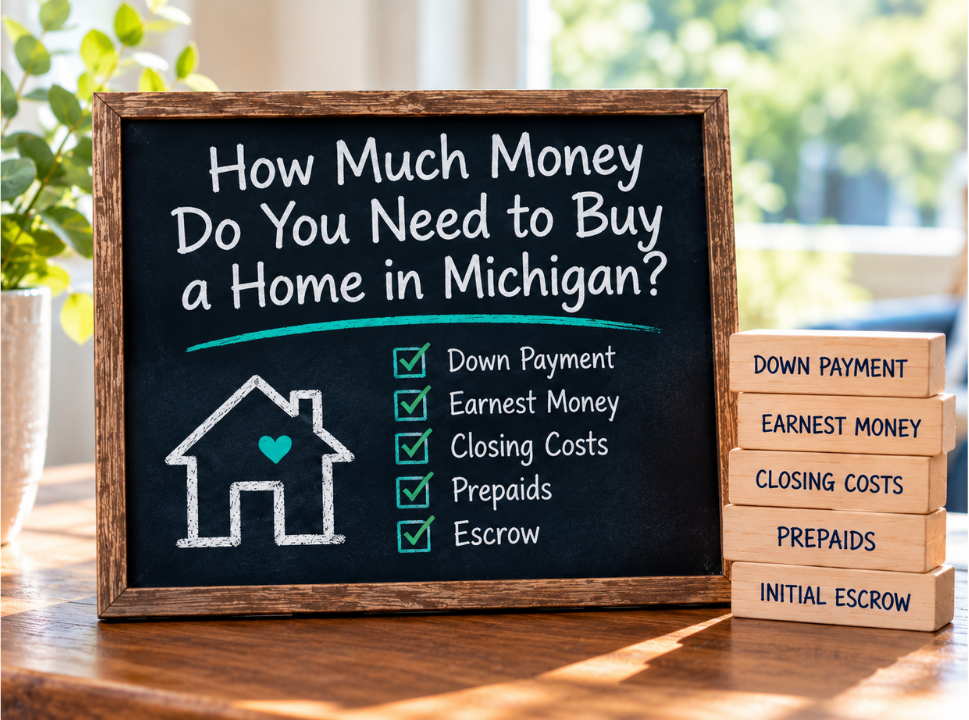
One of the first questions homebuyers ask is:
“How much money do I need to buy a home?”
And the answer starts with your down payment—but it doesn't end there.
Your down payment goes toward the purchase price of the home. Separate from your down payment, you'll also want to plan for closing costs, prepaid expenses and, in many cases, money to establish an escrow account.
You'll likely hear about earnest money, too. That's another piece of the puzzle, but it works a little differently.
Here's what you need to know.
Your down payment is the portion of the purchase price you pay rather than finance with your mortgage.
And no, you don't necessarily need 20% down.
Depending on the loan program and your qualifications, some conventional loans allow as little as 3% down, while FHA loans require a minimum of 3.5%. Eligible VA and USDA borrowers may have zero-down options.
Let's use a simple example.
If you're buying a $250,000 home with 5% down, your down payment would be:
$12,500
That's the easy part.
But $12,500 isn't necessarily the total amount you'll need to buy the home.
Closing costs are the fees and expenses associated with completing your mortgage and real estate transaction.
They can include things like:
Freddie Mac estimates that closing costs typically range from 2% to 5% of the purchase price, but the actual amount varies from one transaction to another.
So, on our $250,000 example, we know the down payment is $12,500, but we still need to determine the buyer's actual closing costs.
This is an important distinction:
Not everything you pay at closing is a closing cost.
You may also pay certain homeownership expenses in advance. These are called prepaids.
Prepaids can include things such as your homeowners insurance premium and mortgage interest that accrues between your closing date and the period covered by your first regular mortgage payment.
Because these expenses depend on your individual transaction, the amount can vary.
If your mortgage includes an escrow account, money is collected with your monthly mortgage payment to pay expenses such as property taxes and homeowners insurance when they're due.
But that account needs money in it from the beginning.
That's why an initial escrow deposit may be collected at closing.
The amount needed depends on things such as the home's property taxes, insurance costs, when those bills are due and your closing date.
This is one reason two buyers purchasing homes for the exact same price could need different amounts of money at closing.
Earnest money, sometimes called an earnest money deposit or EMD, is money you put down with your offer to show the seller that you're serious about purchasing the home.
Think of it as putting some money behind your offer.
The amount of earnest money, when it's due and the terms surrounding it are written into your purchase agreement.
Here's another important part:
Earnest money isn't an additional expense that simply gets added to everything else.
If you deposit $2,500 in earnest money and the transaction closes, that $2,500 is credited toward the amount you owe at closing.
You've already put that money into the transaction.
What happens to the earnest money if the purchase doesn't close depends on the terms of your purchase agreement.
Depending on your transaction and loan program, you may also have credits that reduce some of the costs you would otherwise pay at closing.
For example, your purchase agreement may include a seller credit toward allowable costs.
There are also mortgage options involving lender credits. These can reduce certain upfront costs, but there can be a tradeoff, such as a higher interest rate.
This is why we look at the entire loan—not just how much money is due on closing day.
There isn't one dollar amount that every Michigan homebuyer should save.
Your loan program, purchase price, down payment, property taxes, homeowners insurance, closing date and purchase agreement can all affect the amount you'll need.
That's why we want to talk about money before you're ready to make an offer.
When you're getting pre-approved, don't just ask:
“How much house can I qualify for?”
Ask:
“How much money should I expect to need?”
Those are two different questions—and understanding both can help you shop for a home with a much better plan.
Buying a home shouldn't come with a surprise number at the closing table.
We'll help you estimate your down payment and the other expenses associated with your purchase so you understand where your money is going and how much you should plan to have available.
Every transaction is different. The goal is to understand yours before you make an offer.
Freddie Mac — Understanding the Costs of Buying a Home
https://myhome.freddiemac.com/blog/homebuying/budgeting-upfront-homebuying-costs
Consumer Financial Protection Bureau — Closing Disclosure Explainer
Consumer Financial Protection Bureau — Prepaid Interest Charges